Three nights in an offbeat Rajasthan town that stayed with us
Some places announce themselves loudly. Bundi does not. It waits.
We reached Bundi in the late afternoon, the sun still warm Before going to our hotel, we stopped at Nawal Sagar Lake. Hunger and curiosity arrived together.
We chose a small restaurant by the lake and sat down for lunch, basking in the winter sun. The fort reflected quietly in the water, the town moving at an unhurried pace around us. It was calm — almost meditative — the kind of calm that arrives not because you seek it, but because the place offers it freely.
Built in the sixteenth century by Raja Nawal Singh for water conservation, Nawal Sagar Lake sits at the heart of Bundi — not as a backdrop, but as its quiet anchor. Over time, palaces, havelis, and walls gathered around it. Stepwells once drew their supply from it, binding the lake to the everyday life of the town.
Up close we saw some litter in the lake, — reminder of neglect amid beauty.
Chhatri at Nawal Sagar Lake
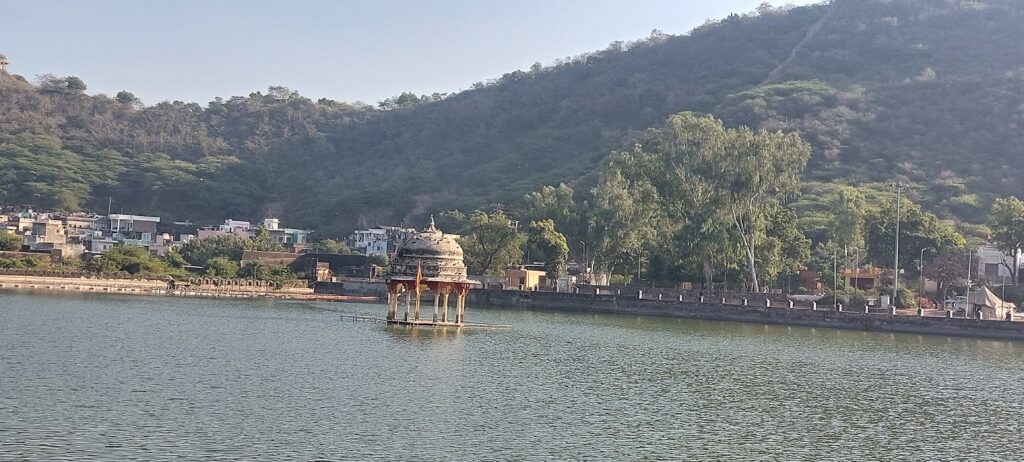
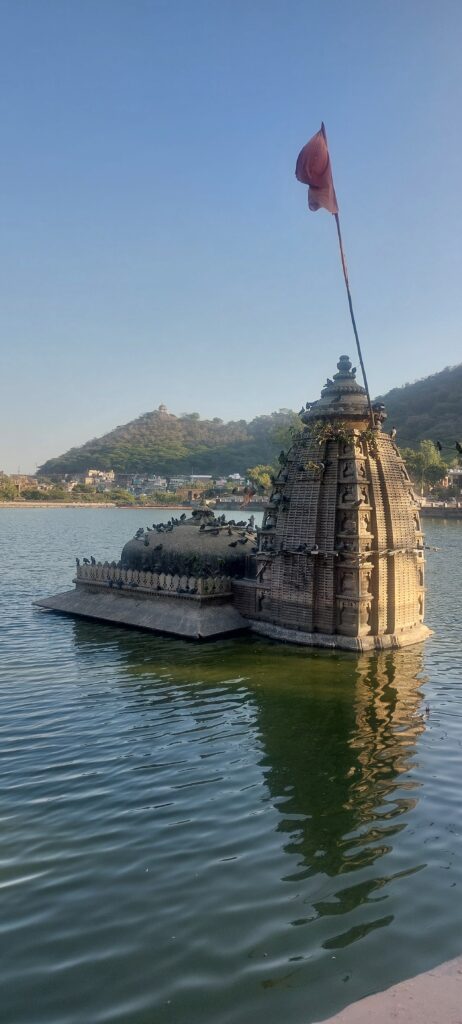
After lunch, we walked slowly around the lake, lingering longer than expected. The Varuna Temple, partially submerged, felt inseparable from the water itself — less a structure placed in the lake and more something claimed by it. Nearby, the chhatri at the centre of the lake stood quietly — simple yet finely crafted, adding to the lake’s quiet grace.
Only then did we head to our hotel.
Varuna Temple at Nawal Sagar Lake
The Town Settles Us In
Our hotel was technically more like a guest house — simple and clean, with no food and very reasonably priced. It was in the centre of Bundi. The lanes were too narrow for our car, so we dropped our luggage at the hotel and parked our car at Garh Palace parking which was walking distance from our guest house.
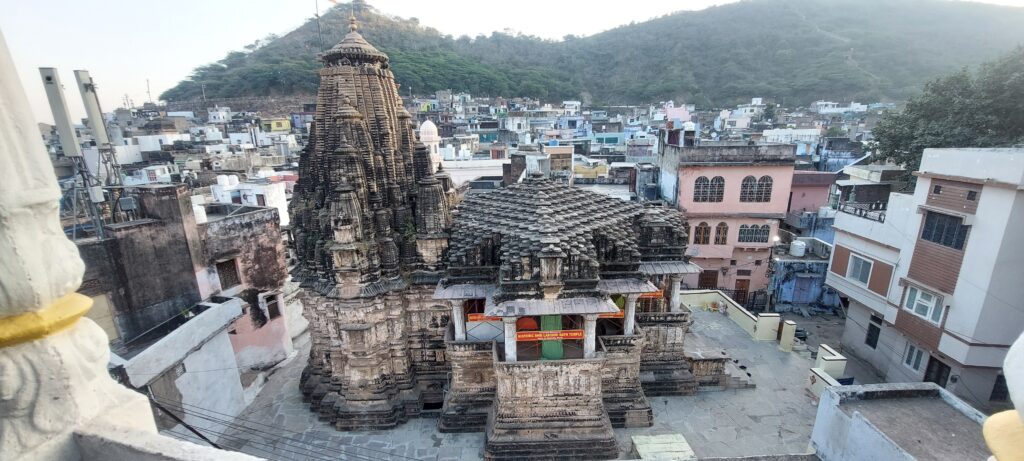
Directly opposite our guest house was Lakshminath Temple, built sometime in the 15th century- architecturally beautiful. Its presence grounded us immediately, as if the town had placed us exactly where we were meant to be.
Lakshminath Temple opposite our guest house
Wandering Into the Evening
As evening settled in, we stepped back into the lanes to look for something to eat. What struck us almost immediately was how effortlessly things came together. Small, beautiful temples appeared at regular intervals, interspersed with eating places — nothing jarring, nothing out of place. Everything was neat and clean. There were very few tourists and the people we encountered were polite, unhurried, and genuinely friendly. Mostly people are vegetarian in Bundi. The atmosphere was calm and peaceful.
A temple
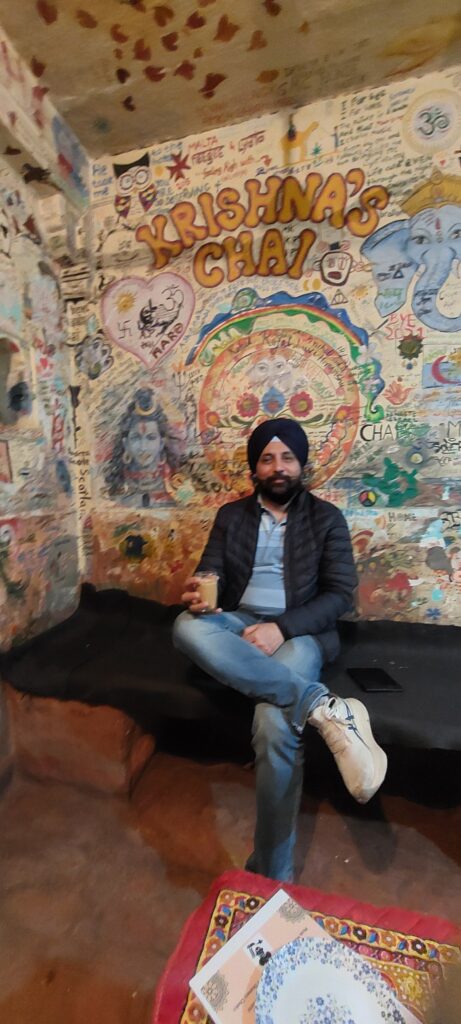
We found Krishna’s Chai — a quaint little shop whose walls are covered in graffiti and messages left behind by travellers from all over the world. It felt less like a café and more like a shared memory. The owner was warm and lively. We had masala chai & lemon tea— simple, strong, comforting .
Husband having Chai
There, we met a local tour guide who casually suggested dinner at Dev Niwas, a nearby heritage property converted from a haveli. We took his advice and walked there.
Dinner was on the top floor. And when we reached the top, lo and behold , Garh Palace and Taragarh Fort stood before us, lit up against the night sky — solid, luminous, almost unreal. The food was good, but the view was something else entirely.
That was the moment we fell in love with Bundi.
Majestic Garh Palace & Taragarh fort
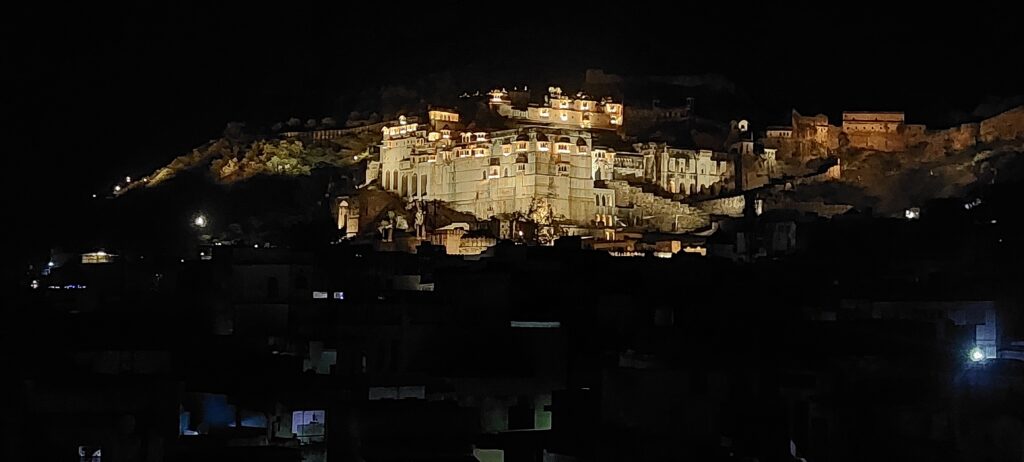
Not gradually.
Not cautiously.
But completely.
Even though our rooms were already booked in the guest house, we enquired if we could book rooms at Dev Niwas, but were told that bookings were done only online. So we returned to our guest house.
The next morning, luck was with us. We managed to book the last available rooms at Dev Niwas.
The Fort That Watches Without Speaking
The next morning, we walked to Garh Palace, also known as Bundi Palace. It is perched high above the town. The entrance to the palac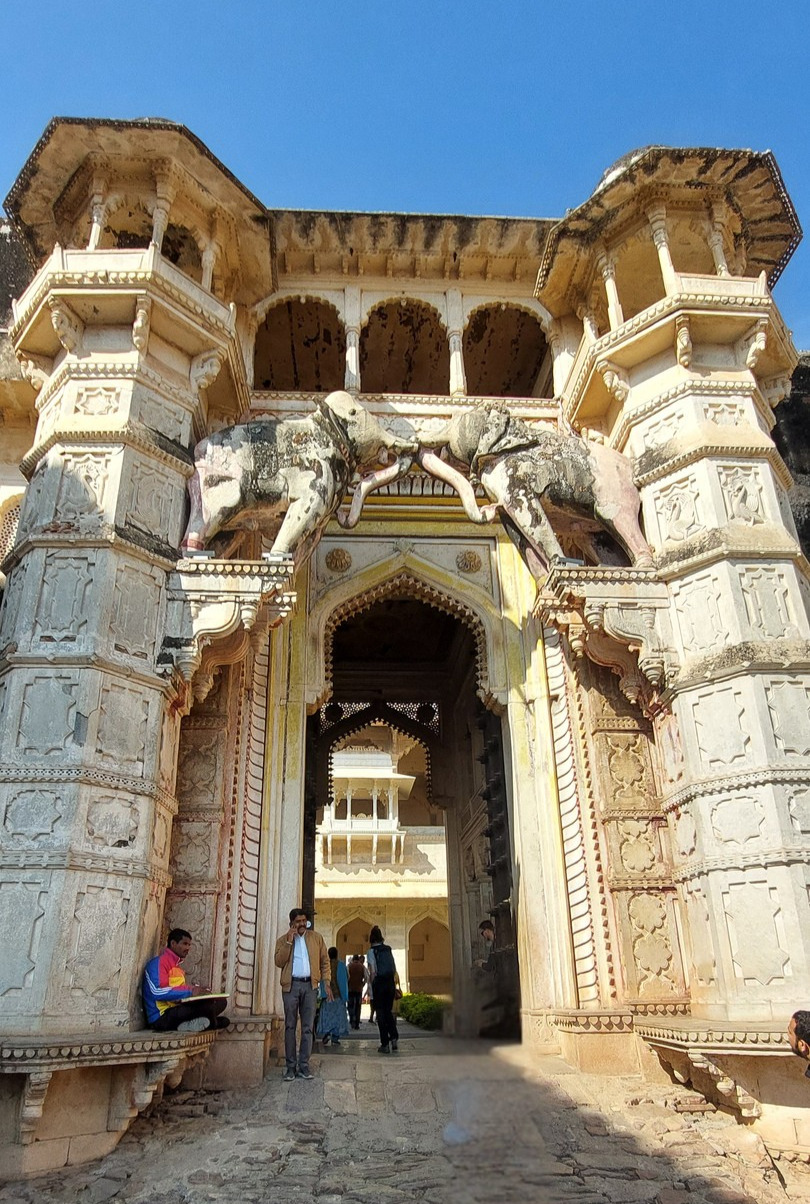 e is is through a large gateway called Hathi Pol, meaning Elephant gateway.
Rudyard Kipling is believed to have spent time in Bundi, and he famously described the palace as “the work of goblins rather than of men.” Its construction began in the seventeenth century. Garh Palace is not a single structure — it is a collection of palaces, added to by different rulers over time.
We walked through Chhatra Mahal, admiring its exquisite murals, and then to Badal Mahal, named because of its lofty position and open light. The palace complex is vast and involves a fair amount of walking, including steep sections. My father was not able to see the entire palace, so while we continued exploring, he rested within the palace grounds — content to sit and absorb the atmosphere.
We spent a long time at the Chitrashala. Scenes from mythology, court life, and everyday moments unfolded across the walls with remarkable detail. The paintings were vivid but never theatrical.
From the palace, Bundi lay spread out below — blue doors, tiled roofs, quiet lanes gathered together. Seen from above, the town felt intimate, almost held.
The palace and the Chitrashala are majestic, yet they show signs of neglect. Maintenance feels uneven. But still, the place holds its power — not through polish, but through presence.
The One Place We Couldn’t Go
We had hoped to visit Taragarh Fort, but a leopard sighting the previous night had led security to restrict access.
Oddly, the inability to go felt fitting.
Not everything, we realised, is meant to be entered.
Some places are meant to be acknowledged from a distance.
Letting the Town Lead Us
After the palace, we felt unexpectedly energised. We took an auto-rickshaw and asked the driver to simply show us Bundi.
What a gem of a person he was.
He first took us to Kshar Bagh, the royal cremation grounds of Bundi’s rulers, set opposite Sukh Sagar Lake. The cenotaphs were architectural marvels — intricately carved, dignified, and deeply moving. The caretaker explained the history beautifully, with care and clarity.
From there, we went to the 84-pillared cenotaph, dedicated to Lord Shiva — once again, an exercise in balance and craftsmanship.
Next came Raniji ki Baori, the Queen’s Stepwell. Descending into it felt like entering a cooler, older world. The carvings were intricate and astonishingly intact — a reminder of how central water once was to life and design.
By then, hunger found us again. We stopped for a sumptuous lunch at a Punjabi dhaba, then returned to our hotel to rest.
In the evening, we went back to Krishna’s Chai — and had our masala chais & lemon tea. And later that night, despite the cold, we found ourselves once again on our hotel’s rooftop, having dinner while the palace and fort glowed softly in the dark.
Some views ask to be admired once.
Others ask to be returned to.
Water, Everywhere
One of the quiet surprises of Bundi was the water bodies.
We walked around Jait Sagar Lake, quieter than Nawal Sagar, fringed by trees and old structures. Nearby stood Sukh Mahal, where Rudyard Kipling is believed to have stayed, drawing inspiration for Kim. The building itself is modest, but its setting — light, water, breeze — explains its appeal without words.
In Bundi, water is not ornamental.
It is structural.
Emotional.
Enduring.
Beyond the Town
The next day we ventured out to places that spoke of much older histories.
At the Bhimlat Cave, we saw prehistoric cave paintings — estimated to be thousands of years old. Standing there, it was impossible not to feel the weight of time.
Nearby, Bhimlat Waterfall added sound and movement to the stillness. Even though it was not monsoon, the waterfall was still awesome. It is a must go in the monsoon period. Local legend links the waterfall to Bhima, one of the Pandavas, who is said to have struck the ground during exile to release water and quench his thirst — giving the place its name, Bhimlat, from Bhim and lat, meaning a kick. Bhimlat Mahadev Temple is situated near the waterfall.
A drive further took us to the beautifully carved Bijolia temples built around 11th-13th century, where stone, age, and landscape blended seamlessly. These places did not feel curated. They felt discovered.
What Bundi Gave Us
By the end of three nights, something had shifted.
No one complained of boredom. No one checked the clock too often. The itinerary loosened and reshaped itself. We followed mood more than plan.
Bundi gave us:
- quiet mornings
- unhurried evenings
- conversations without urgency
- beauty without performance
It did not demand attention.
It rewarded it.
And when we finally left, it felt less like departure and more like being gently released.
🌿